Building a stirling engine

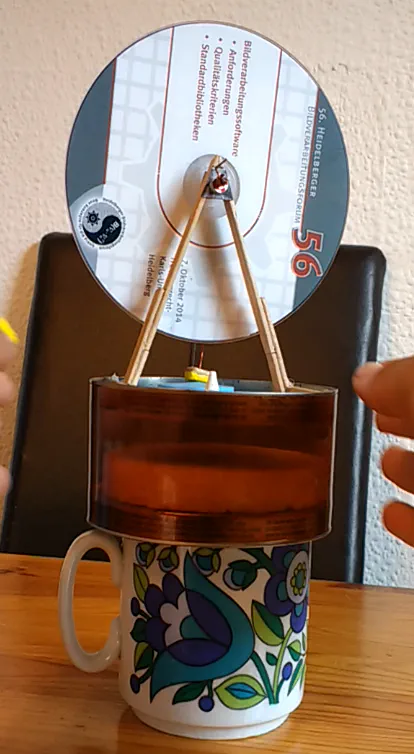 Image credit:
A Stirling engine is a type of heat engine that operates by cyclically compressing and expanding a fixed quantity of gas, converting thermal energy into mechanical motion. This project involved building a functional Stirling engine from everyday household materials, following a tutorial from YouTube, to compete in the Explore Science competition.
The engine was constructed using simple items like a CD, ice cream sticks, a plastic bottle, and candy jar lids, demonstrating the potential of basic materials to create working models of complex mechanisms. In this design, the CD serves as the engine’s flywheel, while the candy jar lids form the displacer and power pistons. Ice cream sticks were used for the frame and connecting rods, with each component carefully assembled to allow smooth operation. The engine operates by placing a heat source under one side (such as a candle or warm surface) and a cooler environment or cooling source on the other, allowing the gas inside the bottle to expand and contract in a continuous cycle.
This Stirling engine exemplifies the principles of thermodynamics in a hands-on, accessible way. The engine runs quietly and smoothly as thermal energy is converted into mechanical energy, driving the flywheel with minimal input. Despite the simplicity of the materials, the build demonstrates both creativity and precision in design, meeting the challenge of creating a functional, low-cost engine.