Building a crystal radio

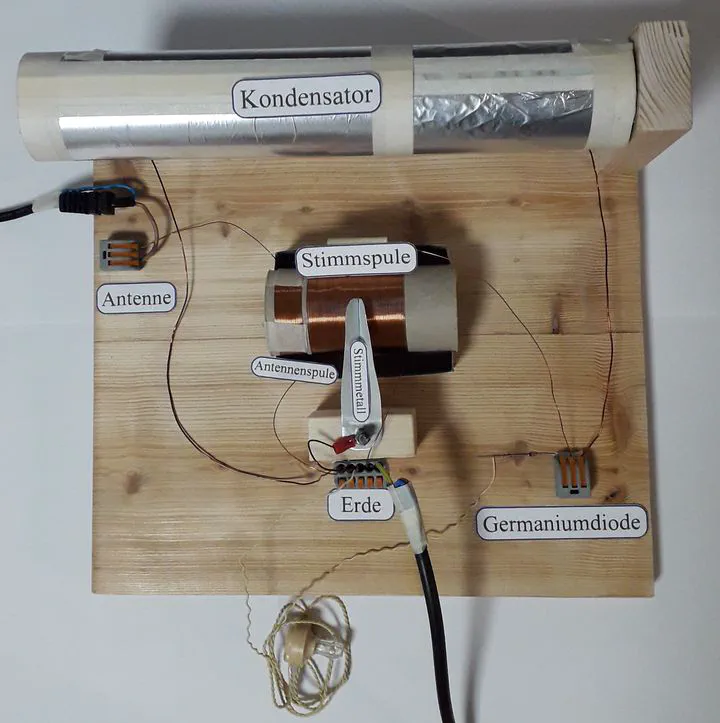 Image credit:
A crystal radio is a simple, passive AM radio receiver that operates without any external power source. It uses the natural energy of radio waves to receive broadcasts, typically within the AM frequency range. These radios were popular in the early 20th century due to their straightforward design, and they remain a fascinating project for hobbyists today.
In this project, I constructed a functional crystal radio using common household materials. The design includes essential components such as an antenna, tuning coil, capacitor, germanium diode, and a sensitive earphone. The antenna captures radio waves, while the tuning coil (often combined with an adjustable component like a slider or variable capacitor) and capacitor work together to form a resonant circuit. This circuit selectively amplifies a specific frequency, allowing the radio to “tune in” to individual AM stations. The germanium diode acts as a detector, converting the radio-frequency signal into an audio signal by rectifying the alternating current. The audio signal is then delivered to the earphone, which produces sound.
Using this homemade receiver, I successfully tuned into a faint AM station from Belgium. This success demonstrates the crystal radio’s sensitivity to distant broadcasts, even without a power source. This project highlights the ingenuity of early radio technology and offers a hands-on understanding of fundamental radio principles.